
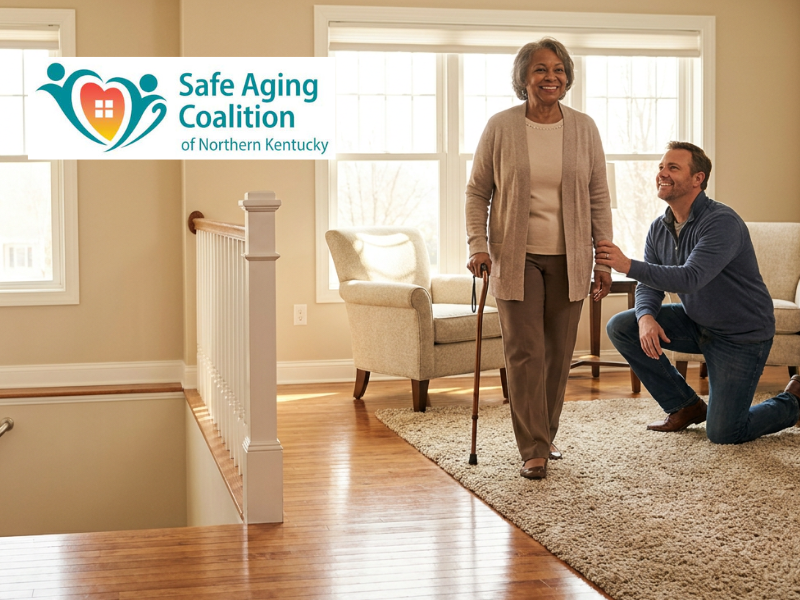
Aging in Place Safely: A Senior Home Safety Checklist for Northern Kentucky
Most older adults want to remain independent and comfortable in their own homes. However, familiar rooms can contain overlooked hazards—from dim hallways and loose rugs to crowded walkways and poorly placed household items.
The good news is that many home safety risks can be addressed through simple, practical changes. This senior home safety checklist explains how older adults, family caregivers, and community members can create safer living environments and reduce the risk of falls.
The Safe Aging Coalition of Northern Kentucky (SACofNKY) supports aging and at-risk adults through fall-prevention education, demonstrations, resources, and community programs. Its services reach residents of Boone, Campbell, Carroll, Gallatin, Grant, Kenton, Owen, and Pendleton counties.
What Does Aging in Place Mean?
Aging in place means living safely and independently in the home and community of your choice as you grow older. Successful aging in place often requires planning for changes in mobility, vision, strength, balance, and everyday routines.
A safer home does not need to look like a medical facility. Small improvements—such as better lighting, open walking paths, and secure handrails—can preserve comfort while supporting independence.
The best time to evaluate home safety is before a fall occurs. Families should make decisions with the older adult, not simply for them. This respectful, collaborative approach helps ensure that changes meet the individual’s priorities and needs.
Why Is Fall Prevention an Important Part of Home Safety?
A fall can affect mobility, confidence, and the ability to complete everyday activities. After falling, some older adults may begin avoiding movement because they are afraid of another incident. Unfortunately, becoming less active may contribute to reduced strength and balance.
Fall prevention is not about taking away freedom. It is about removing unnecessary hazards so an older adult can move through the home with greater confidence.
Because falls often have more than one contributing factor, an effective safety plan should consider the home environment, personal health, daily habits, footwear, medications, vision, and mobility equipment.
Senior Home Safety Checklist by Room
Walk through the home during both the day and evening. Conditions that appear safe in daylight may be difficult to navigate at night.
Entrances and outdoor areas
A safe entrance helps older adults leave and return home with confidence.
Check that:
- Steps and walking surfaces are level and in good condition.
- Railings are secure and easy to grip.
- Outdoor lights illuminate stairs, doors, and pathways.
- Leaves, hoses, packages, and other objects are removed promptly.
- Frequently used entrances are not blocked.
- Water, snow, and ice are addressed as soon as possible.
- The house number is visible to emergency responders.
Place commonly used items, such as keys, where they can be reached without stretching or rushing.
Living room
Living rooms may become crowded with furniture, cords, decorative objects, and items used throughout the day.
Make sure:
- Walking paths are wide and unobstructed.
- Electrical cords are kept away from foot traffic.
- Rugs lie flat and have effective nonslip backing.
- Chairs are stable and easy to enter and exit.
- Tables do not block common routes.
- Lamps can be turned on without crossing a dark room.
- Pet toys and other small objects are picked up regularly.
Removing clutter does not require giving up everything meaningful. Begin with high-traffic areas and focus on objects that create immediate hazards.
Bedroom
The route between the bed and bathroom deserves special attention because it is frequently used at night.
Check that:
- A lamp or light switch is accessible from the bed.
- Nightlights illuminate the bedroom, hallway, and bathroom.
- The path to the door is completely clear.
- Bedding does not hang onto the floor.
- A telephone is within easy reach.
- Eyeglasses and mobility aids have a consistent storage location.
- The bed is at a manageable height.
SACofNKY recognizes the importance of nightlights as a practical tool for preventing falls in the home.
Bathroom
Wet surfaces and limited space can make bathrooms challenging to navigate.
Consider whether the bathroom has:
- Nonslip surfaces in and around the bathing area.
- Adequate lighting for nighttime use.
- Secure grab bars where professionally recommended.
- A clear path to the toilet and shower.
- Frequently used products within comfortable reach.
- Appropriate bathing equipment for the user’s needs.
- A door that can be accessed in an emergency.
Towel racks and soap dishes are generally not designed to support a person’s weight. Equipment should be selected carefully and installed correctly.
Kitchen
Kitchen safety depends on organization as well as clean, dry floors.
Review whether:
- Frequently used dishes and ingredients are stored within easy reach.
- Spills are cleaned up promptly.
- Step stools are avoided when possible.
- Floor mats lie flat and do not slide.
- Walkways remain free of bags, boxes, and pet bowls.
- Heavy objects are stored at a comfortable height.
- Lighting is bright enough for food preparation and movement.
Reorganizing one cabinet can eliminate the need to climb, bend deeply, or reach overhead several times each day.
Hallways and stairs
Hallways and stairs should remain clear at all times.
Look for:
- Secure handrails.
- Bright lighting at both ends of a staircase.
- Visible step edges.
- Unrepaired carpeting or flooring.
- Objects temporarily placed on steps.
- Light switches that are easy to reach.
Never use stairs as storage, even for items that will supposedly be moved later.
What Daily Habits Can Help Reduce Fall Risks?
Environmental improvements work best when combined with safe daily habits.
Older adults can consider the following practices:
- Wear supportive shoes. Choose properly fitting footwear with stable, nonslip soles.
- Move at a comfortable pace. Rushing to answer a door, telephone, or bathroom need can increase risk.
- Stand up gradually. Pause before walking if you feel lightheaded after leaving a bed or chair.
- Use mobility equipment correctly. Canes, walkers, and other equipment should be suitable for the individual and adjusted properly.
- Discuss vision changes. Difficulty seeing obstacles, steps, or changes in flooring should not be ignored.
- Review medications. Ask a healthcare professional whether prescriptions, nonprescription medicines, or supplements could contribute to dizziness or drowsiness.
- Stay appropriately active. A healthcare professional can help identify activities suited to a person’s health and abilities.
Recurring dizziness, weakness, balance problems, or falls should be discussed with a qualified healthcare provider.
What Should You Do After a Fall?
First, obtain appropriate medical assistance, especially if the person has pain, hit their head, cannot get up, or may be injured. Do not rush to move someone when an injury is possible.
After immediate needs have been addressed, consider what contributed to the incident:
- Where and when did it happen?
- Was the area dark, wet, uneven, or cluttered?
- Was the person rushing?
- Did dizziness or weakness occur?
- Was appropriate footwear being worn?
- Was a cane, walker, or other device available and used correctly?
- Has there been a previous fall or near-fall?
The goal is not to blame anyone. It is to identify preventable hazards and determine whether additional support is needed.
Find Fall-Prevention Help in Northern Kentucky
Founded as a nonprofit organization in 2016, the Safe Aging Coalition of Northern Kentucky is a volunteer collaboration focused on the health, wellness, and safety of aging and at-risk adults.
SACofNKY provides awareness, education, and demonstrations related to safe aging, with a primary emphasis on fall prevention. Its educational presentations include:
- This Little Light of Mine: Illuminating the Path to Fewer Falls
- Less Stuff, Fewer Falls, More Life
- Roadmap to Navigating Change
The Coalition also supports online learning, community services, health and wellness initiatives, nightlight programs, and access to durable medical equipment resources.
Visit SafeAgingNKY.org to explore fall-prevention tips, educational videos, events, resources, volunteer opportunities, and ways to support safer aging throughout Northern Kentucky. You may also call 859-250-9134 for more information.
A safer home begins with one manageable improvement. Turn on a light, clear a walkway, secure a handrail, or start a family conversation today.